
The La Masia World Cup Final: How One Academy Came to Define Football’s Greatest Stage
From the training pitches of Barcelona to the biggest stage in world football, this World Cup final is about more than just Argentina and Spain. It’s the story of La Masia, the academy that shaped Lionel Messi and now nurtures Lamine Yamal. As football’s greatest icon faces its brightest young star, we look at how one philosophy, one academy and one remarkable coincidence have come together to create one of the most compelling World Cup final narratives ever told.
Ananth Shivram
7/19/20265 min read
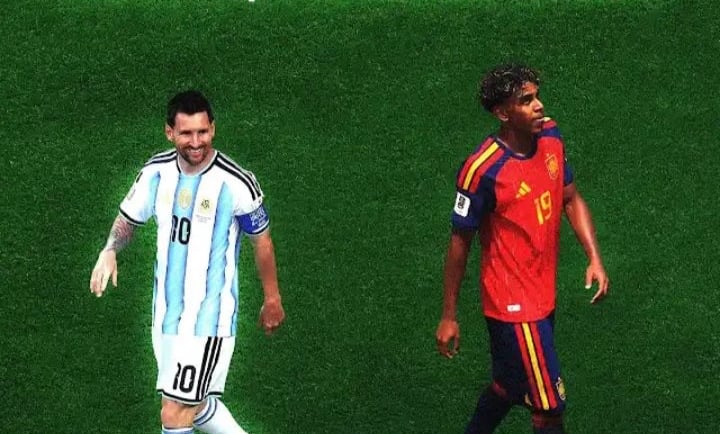
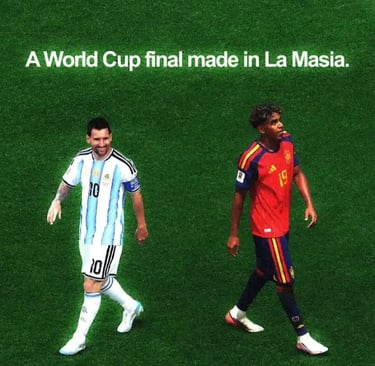
Every World Cup final has its own story.
Some are remembered for legendary goals. Others for tactical masterclasses, giant-killings or moments that become part of football folklore.
This year’s final offers all of that.
Argentina versus Spain.
The defending world champions against the reigning European champions.
Lionel Messi against Lamine Yamal.
The greatest player of his generation against the brightest talent of the next.
But beneath every headline and every tactical discussion lies a story that began thousands of miles away from the World Cup, on the training pitches of Barcelona.
A story about one academy.
A story about La Masia.
For decades, La Masia has been regarded as the gold standard in youth development. It has shaped some of the greatest footballers the game has ever seen and, in many ways, redefined how modern football is played.
Tomorrow, two of its most famous graduates will walk out for opposite teams in the biggest match in football.
Whatever happens when the final whistle blows, La Masia has already cemented its place in World Cup history.
More Than Just an Academy
To call La Masia simply Barcelona’s youth academy would be doing it a disservice.
It is a philosophy.
While most academies focus on producing physically gifted footballers, La Masia has always prioritised intelligence, technique and decision-making.
Young players are taught to understand space before they learn systems. They are encouraged to keep possession under pressure, press immediately after losing the ball and constantly think one or two passes ahead.
Every age group is coached in the same philosophy so that progression through the ranks feels natural rather than disruptive.
The aim isn’t just to develop footballers.
It is to develop footballing minds.
That philosophy has produced an extraordinary list of graduates.
Xavi Hernández.
Andrés Iniesta.
Sergio Busquets.
Carles Puyol.
Gerard Piqué.
Pedro.
Cesc Fàbregas.
Gavi.
Alejandro Balde.
Pau Cubarsí.
Lionel Messi.
Lamine Yamal.
Few academies in world sport can claim to have influenced football the way La Masia has.
Its impact wasn’t confined to Barcelona either.
Spain’s historic run of winning Euro 2008, the 2010 FIFA World Cup and Euro 2012 was built around players who had grown up together at La Masia, playing the same style of football long before they ever represented their country.
Club philosophy became international dominance.
The Boy Who Changed Football
Messi’s journey with Barcelona has become one of football’s greatest stories.
In 2000, a shy 13-year-old arrived from Rosario carrying enormous talent but an uncertain future.
Diagnosed with a growth hormone deficiency, opportunities in Argentina had become increasingly difficult.
Barcelona saw something others couldn’t.
They offered him treatment, opportunity and, perhaps most importantly, a footballing home.
La Masia didn’t create Messi’s talent.
It refined it.
His dribbling became more purposeful.
His understanding of space became almost impossible to defend.
His decision-making reached levels few players have ever matched.
The academy provided the environment where raw ability became sustained greatness.
The rest is football history.
Four Champions Leagues.
Countless league titles.
Eight Ballons d’Or.
Hundreds of goals.
Records that may never be broken.
And, finally, the one trophy that completed his legacy—the FIFA World Cup.
Now, as defending champions, Messi stands one victory away from achieving something only Italy (1934 & 1938) and Brazil (1958 & 1962) have managed before—winning consecutive World Cups.
The Boy Carrying Football’s Future
If Messi represents football’s past, Lamine Yamal represents its future.
Still only a teenager, Yamal has already achieved what many professionals spend entire careers chasing.
A regular for Barcelona.
A European champion with Spain.
Now, a World Cup finalist.
His rise has been breathtaking not simply because of his age but because of how naturally he seems to belong.
Nothing appears rushed.
Nothing feels overwhelming.
He plays with the composure of someone ten years older.
That is perhaps La Masia’s greatest gift.
Yamal possesses the technical brilliance expected of every Barcelona graduate, but what truly separates him is his understanding of the game.
He rarely forces the spectacular.
Instead, he consistently chooses the correct decision before defenders even recognise the danger.
Those qualities feel familiar.
Not because he is another Messi.
Football may never produce another Messi.
But because he has been shaped by the very same footballing education.
Argentina’s Road to the Final
World champions always carry a target on their backs.
Argentina arrived knowing every opponent wanted to become the team that dethroned them.
Yet Lionel Scaloni’s side have once again shown why they have become one of international football’s benchmark teams.
The group stage was navigated comfortably, but the knockout rounds demanded resilience.
Cape Verde produced one of the stories of the tournament but couldn’t stop the champions.
Egypt pushed Argentina in an entertaining encounter.
Switzerland tested their patience and resilience.
Then came England.
A semi-final worthy of the occasion.
England looked set to reach their first World Cup final since 1966 after taking the lead, only for Argentina to remind everyone why champions are never beaten until the final whistle.
As they have done throughout Scaloni’s reign, Argentina found another level when it mattered most.
At the heart of it all has been Messi.
Even in his sixth World Cup, he continues to dictate matches, create moments of magic and lead with a calmness that only the very greatest possess.
Spain’s Road to the Final
If Argentina have embraced drama, Spain have embraced control.
Fresh from winning the European Championship, they have looked every bit a team entering their prime.
Possession has been their greatest weapon.
Portugal struggled to escape Spain’s relentless pressing.
Belgium found themselves chasing shadows.
Then came France.
World champions in 2018.
Finalists in 2022.
One of the tournament favourites.
Spain simply outplayed them.
Their movement, passing and positional discipline proved too much as they booked only their second World Cup final.
Remarkably, Spain have conceded just one goal throughout the tournament.
Their campaign has been built less on individual brilliance and more on collective excellence—a hallmark of every great Spanish side.
It is football played with patience, precision and purpose.
In many ways, it is football that still carries the fingerprints of La Masia.
More Than Messi vs Yamal
Every World Cup final has a defining narrative.
This one has several.
South America against Europe.
The defending world champions against the reigning European champions.
Lionel Scaloni against Luis de la Fuente.
Experience against youth.
But perhaps the biggest story isn’t about tactics or even the players themselves.
It is about a philosophy.
For more than four decades, La Masia has shown that sustained success isn’t simply bought in the transfer market.
It is built.
Built through patience.
Built through identity.
Built through teaching generations of young footballers not just how to play, but how to think.
That philosophy shaped Lionel Messi.
Today, it shapes Lamine Yamal.
Nineteen years separate them in age, yet both arrived in Barcelona as gifted youngsters, wore the famous Blaugrana colours before adulthood and learned the same footballing language on the training pitches of La Masia.
Tomorrow, they will stand on opposite sides of the biggest game in world football.
Only one nation will leave the stadium as world champions. It could be Argentina becoming the first team in over six decades to successfully defend the World Cup. It could be Spain adding another star to their crest and reaffirming themselves as the standard-bearers of international football.
For Messi, it could be the perfect final chapter to a career that has already redefined greatness. For Yamal, it could be the first chapter of what many believe will be a remarkable journey.
Yet perhaps the most remarkable image connected to this final wasn’t taken on a football pitch at all.
In 2007, during a UNICEF charity calendar photoshoot, a 20-year-old Lionel Messi gently held and bathed a six-month-old baby. It was simply another community event, another photograph, with no way of knowing the story it would one day tell.
That baby was Lamine Yamal.
Seventeen years later, nine La Masia graduates will feature in a World Cup final—eight for Spain and one for Argentina. Among them are the two faces that define this occasion: one chasing history, the other chasing his first World Cup. Both are products of the same academy. Both now stand on opposite sides of football’s biggest stage.
Sometimes football writes stories that no scriptwriter could imagine.
This is one of them.