
From Heartbreak to Queen of Hearts : The 20-Year Journey of Indian Women's Cricket to Finish Her Story
From forgotten beginnings to the pinnacle of world cricket - this is the story of how India's women turned decades of heartbreak into history. From 2005's quiet beginnings to 2017's pain and finally 2025's glory, this is the tale of belief, resilience, and the rise of the Queens of Cricket.
Ananth Shivram
11/3/20258 min read
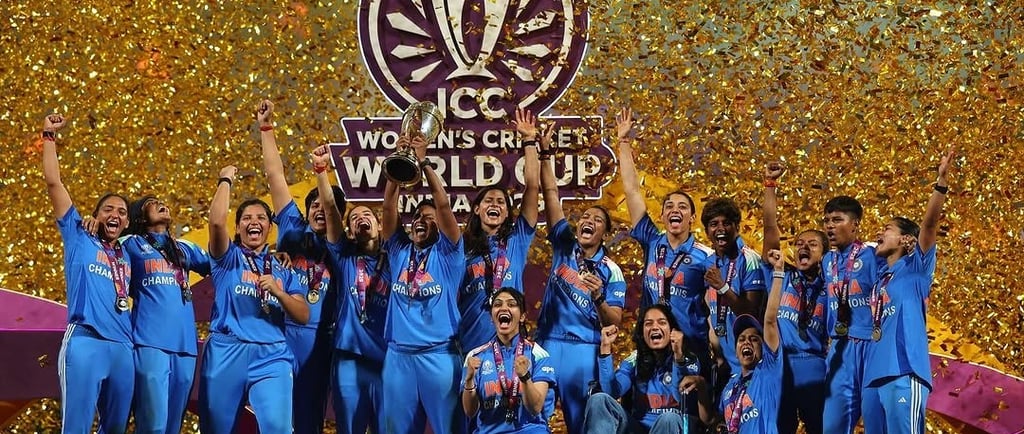
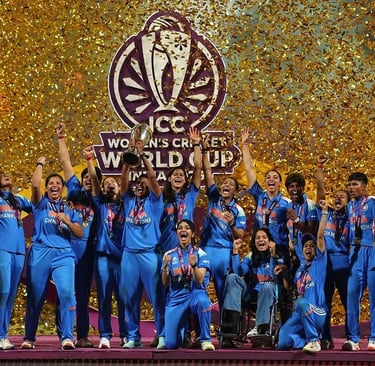
As the clock neared midnight and on 02nd November 2025, skipper Harmanpreet Kaur held on to a sharp catch at extra cover — sealing India’s place in cricketing folklore and crowning this team as the Queens of World Cricket. The celebrations erupted across the D.Y. Patil Stadium, but amidst the roar and fireworks, the camera caught a quiet, emotional moment — Rohit Sharma, in attendance, looking up at the sky with a tear rolling down his cheek.
Rohit, the former Indian men’s captain, knew this feeling all too well. He had led an unbeaten India to the 2023 World Cup Final, only to fall short against Australia. Though he found redemption a year later by lifting the 2024 T20 World Cup in Barbados, the sting of that night in Ahmedabad had never truly left him.
For India’s women, that same heartbreak had lingered across decades — from 2005 to 2017, from close calls to quiet exits, from near-misses to national hope.
This win was not just about lifting a trophy; it was about finishing a story that began years ago — one built on heartbreak, belief, and unshakeable resolve.
Let’s look back at the journey that built this moment — one born of heartbreak, driven by belief, and destined for glory.
World Cup Final 2005: The First Steps Toward a Dream
There’s no better place to start than the day the Indian women’s team truly put the world on notice.
India had beaten New Zealand in the semi-final of the 2005 World Cup, played in South Africa, and entered their first-ever World Cup Final on the back of a match-winning 91* from 22-year-old captain Mithali Raj.
What awaited them in the final was a gun Australian side chasing their fifth World Cup title — a team stacked with stars like Belinda Clark, Lisa Sthalekar, and Mel Jones, names that many fans today recognize in their roles as commentators.
India entered the final banking on their bowling unit, bolstered by the tournament’s top three wicket-takers: Neetu David, Anita Sharma, and a 22-year-old sensation — Jhulan Goswami.
What followed that day evoked memories of the men’s World Cup Final in 2003. Batting first, Australia posted 215/4, powered by a brilliant 107* from Player of the Match Karen Rolton. It was always going to be a formidable total in those conditions, and India eventually fell short by 98 runs, bowled out for 117.
While the fairy-tale ending didn’t arrive, the tournament unearthed two 22-year-olds who would become the torchbearers of Indian women’s cricket for the next two decades —
Mithali Raj, our captain and highest run-scorer to date, and Jhulan Goswami, our all-time leading wicket-taker, fondly known as the Chakda Express.
World Cup Semi-Final 2017: Harman’s Blitzkrieg That Stunned the World
In the two World Cups that followed — 2009 and 2013 (hosted in India) — the Indian women’s team failed to reach the semi-final stage.
By 2017, however, things looked different. Bolstered by the experienced core of captain Mithali Raj and Jhulan Goswami, India had unearthed a new generation of talent — Harmanpreet Kaur (28), Smriti Mandhana (20), and Deepti Sharma (19) — players who would go on to define the next decade of Indian women’s cricket. This blend of youth and experience carried India back into the semi-finals, where a familiar foe awaited — defending champions Australia.
The Australians, as ever, were stacked with talent. Alex Blackwell and Rachael Haynes anchored a side featuring their prime core — Meg Lanning, Ellyse Perry, Alyssa Healy, Beth Mooney, and Megan Schutt. Nearly the entire squad had already tasted World Cup glory. It would take something extraordinary to stop them.
Step forward — Harmanpreet Kaur.
Batting first in a rain-shortened 42-over clash in Derby, Harmanpreet produced one of the greatest World Cup innings ever seen — a jaw-dropping 171 off 115 balls* — powering India to a formidable 281/4.
An all-round bowling effort then sealed the job, restricting the mighty Australians to 245, despite valiant knocks from Elyse Villani and Alex Blackwell.
Next stop — Lord’s. The Final against England.
World Cup Final 2017: The Heartbreak at Lord’s
The stage was set — Lord’s, the home of cricket, hosting India’s first World Cup Final in twelve years. For a generation that had grown up watching Mithali Raj and Jhulan Goswami carry Indian women’s cricket on their shoulders, this felt like destiny coming full circle.
The opponents, England, were familiar but formidable. Backed by a packed home crowd and a lineup featuring Heather Knight, Natalie Sciver, and Anya Shrubsole, they were out to reclaim their crown. India, meanwhile, carried a nation’s hopes — and the belief that this time, the script might finally change.
Chasing 229, India were in touching distance of glory. Poonam Raut’s steady 86 and Harmanpreet Kaur’s composed 51 had brought them within 38 runs of history, with seven wickets still in hand. But then came the twist no Indian fan will ever forget.
Anya Shrubsole’s devastating spell — 6 for 46 — tore through India’s lower order, as the team stumbled from 191/3 to 219 all out. Just ten runs short.
Just one partnership away.
Just one moment from rewriting history.
As tears rolled down the faces of Mithali Raj and Jhulan Goswami, the heartbreak was unmistakable — but so was the pride. For the first time, millions back home had watched, cared, and believed. The Indian women’s team had captured hearts, even without the trophy.
T20 World Cup 2020: A New Stage, A Familiar Heartbreak
Three years later, the heartbreak of Lord’s had slowly turned into motivation. A younger, hungrier Indian side began making waves in the shortest format — a version of the game that suited their flair, energy, and fearlessness.
The 2020 ICC Women’s T20 World Cup in Australia was different from anything India had experienced before. A new core had begun to lead the charge: Shafali Verma, barely 16, was taking on world-class bowlers with unshakable confidence, while Smriti Mandhana, Harmanpreet Kaur, and Poonam Yadav formed the spine of a team that suddenly looked capable of beating anyone, anywhere.
India stormed through the group stage unbeaten, including a statement win against Australia in the tournament opener. For the first time, they had the swagger of genuine contenders.
And then came the final — Women’s Day, the MCG, 86,000 fans, and the world watching. The stage couldn’t have been bigger.
But sport, as it often does, reminded us how cruel it can be. On the day it mattered most, India froze under pressure. Australia, ruthless as ever, through Alyssa Healy’s explosive 75 and Beth Mooney’s calm authority posted 184/4 in their twenty overs. In response, India lost a few quick wickets and never recovered as they were bundled out for 99, losing by 85 runs. India’s dream run ended in heartbreak once again — this time, on the grandest stage the women’s game had ever seen.
As the Australian celebrations filled the Melbourne night, the Indian team’s silence spoke louder than words. It wasn’t just about losing a final — it was the feeling of coming so close, again
But something had changed.
The world had noticed.
And this time, the heartbreak didn’t break them — it built them.
World Cup Semi-Final 2025: When Belief Beat the Odds
India were hosting the Women’s World Cup in 2025, and there was a buzz around the tournament. With the launch of the Women’s Premier League in 2023, many of the players had become household names — Harmanpreet Kaur, Smriti Mandhana, Jemimah Rodrigues, and Deepti Sharma.
Yet, one sentiment remained unchanged: to be world champions, you have to get through Australia.
Australia entered the World Cup as firm favourites, seven-time world champions and in the group stage encounter against India, they had chased down a world-record 330 runs on the back of Alyssa Healy’s brilliant 142.
India, meanwhile, had endured a shaky group stage — losing to South Africa and England in matches they had no right to lose. Against South Africa, they had them 142/6 chasing 252; against England, they needed just 55 off 53 balls when Smriti Mandhana fell chasing 289.
A must-win victory over New Zealand set up a semi-final date with, fittingly, the defending champions — Australia.
Batting first, Australia posted a commanding 338, powered by Phoebe Litchfield’s stunning 119 and Ellyse Perry’s fluent 78. At the interval, the mood among fans was somber. And when Smriti Mandhana fell with India reeling at 59/2, a heavy silence hung over the D.Y. Patil Stadium.
What followed defied belief.
Jemimah Rodrigues (127*) and Harmanpreet Kaur (89) led a fearless counterattack, with late surges from Deepti Sharma (24 off 17), Richa Ghosh (26 off 16), and Amanjot Kaur (15 off 8). Australia stood stunned — India had pulled off the unthinkable and marched into another final, this time on home soil.
World Cup Final 2025: The Queen’s Crowning Moment
The morning of 02nd November 2025 started with a downpour in the City of Dreams, Mumbai. However, even the Mumbai rains could not deter a full-house at the D.Y Patil Stadium to cheer on their team, who had through the course of the 2025 World Cup became more than just a team, they became carriers of a nation's faith to witness World Cup glory, and healing the heartbreak of the 2023 Men’s ICC World Cup final defeat in Ahmedabad.
After a rain delay of around 2 hours, Laura Wolvaardt, captain of the South African Women’s team won the toss and put India into bat. India needed a strong start, and could probably use the services of Pratika Rawal, who along with Smriti Mandhana had formed one of the most consistent opening partnerships over the last year. Unfortunately, Pratika Rawal had picked up an injury in the final group game against Bangladesh and was ruled out for the rest of the tournament. In 21 year-old Shafali Verma, India found an able replacement.
Dropped from the ODI team a year back, Shafali Verma was yearning for an opportunity to come her way and took it with both her hands. She combined her natural aggressive style of batting, with a sense of calmness and composure that the occasion demanded, striking 87 off 78 balls, and with contributions from the rest of the batting unit notably Smriti Mandhana (45) and Deepti Sharma (58), India posted a score of 298/7 in their fifty overs.
South Africa were high on confidence as a batting group, and had got to the final on the back of their skipper, Laura Wolvaardt’s sparkling 169. They certainly had the belief they could chase the score down especially after their opening stand lasted 51 runs until a spectacular run-out from Amanjot Kaur had put the brakes on them. Even then at 114/2 in 20 overs, with Laura still around, they were fancying their chances.
In a script that looked like it came straight out of Bollywood, Harman turned to the star with the bat, Shafali Varma and she delivered with two timely blows which broke the back off South Africa’s batting order. Eventually India’s player of the tournament took 5 wickets including the prized scalp of Laura Wolvaardt (101) and the final wicket of Nadine de Klerk to end South Africa’s innings at 246, 52 runs short and sparking wild celebrations across the country.
From the days of 2005, when the Indian women’s team played a World Cup final without even having their own official jerseys, to the heartbreak of 2017 at Lord’s and the anguish of 2020 and 2023, this journey has been anything but easy.
The image of Harmanpreet Kaur staring into the distance after that 2017 final, the tears after the 2020 T20 heartbreak in Melbourne, and the near-misses that followed — they all formed the quiet resolve that led to this night in November 2025.
This was more than just redemption. It was the culmination of two decades of belief, sacrifice, and perseverance — of a team that carried the weight of every heartbreak before them and turned it into history.
From the days of borrowed jerseys to a billion hearts wearing theirs with pride — the Queens of Cricket had finally claimed their crown.