
From Dream to Drop: The Brutal Economics of English Football’s Pyramid
From dream to drop — how promotion and relegation shape the fortunes of football clubs. Through the stories of Leicester City F.C. and Coventry City F.C., this piece explores the financial and structural realities of English football’s pyramid.
Ananth Shivram
4/26/20263 min read
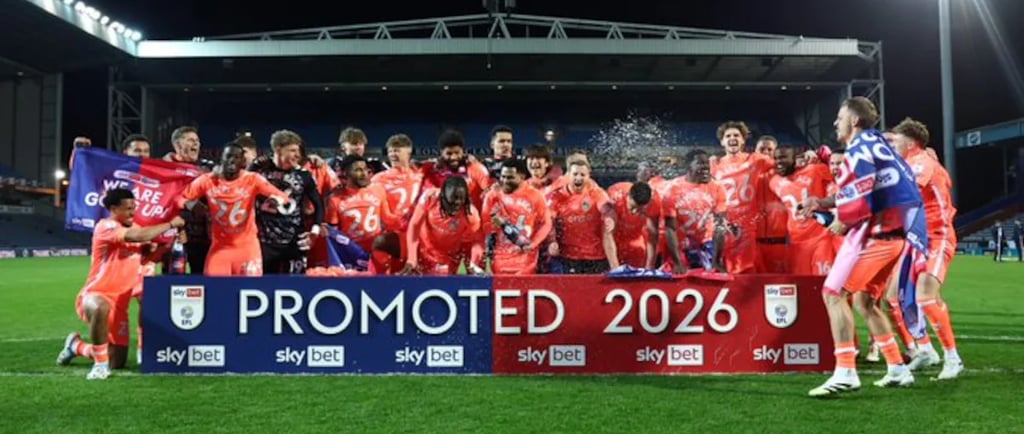
In football leagues across the world, the game is built on a pyramid.
Clubs compete not just to win titles, but to move between divisions — the best rising to the top, the rest fighting to avoid the drop. At the highest level, teams battle to stay in the top division as much as they do to win it, while those below push relentlessly for a chance to break through.
But nowhere is this system felt more intensely than in England.
In the Premier League, success isn’t defined only by how high you climb — but by how well you survive the fall.
Every May, fans across England — and around the world — look beyond the title race.
They watch to see who drops out.
And who fights their way in.
Because the real drama of English football lives at the edges — where promotion and relegation can reshape clubs in a matter of weeks.
Nowhere is that tension more visible than in the EFL Championship.
A league where the reward isn’t just going up.
It’s stepping into a different financial reality.
How Promotion and Relegation Works in England
The structure is simple.
Each season:
The top two teams in the Championship are promoted
Teams finishing 3rd to 6th compete for the final promotion spot in a playoff style mini tournament culminating in a single game playoff final at Wembley Stadium, often called the richest match in football.
The bottom three teams in the Premier League are relegated
It’s a system built on movement — a pyramid where every club, in theory, can rise or fall.
But in the modern game, that movement comes with consequences far beyond the pitch.
Because changing leagues doesn’t just change competition.
It changes economics.
The Financial Cliff
A club in the Premier League earns roughly £100m–£160m per season through broadcast and central revenues.
In the EFL Championship, that drops to around £7m–£10m.
That’s a fall of over 85–90% overnight.
But the bigger problem often lies in wages.
Many Premier League clubs operate with wage bills of £80m–£150m, while Championship clubs typically function closer to £20m–£40m.
Relegation doesn’t just reduce income.
It leaves clubs trying to sustain Premier League costs with Championship revenue.
To soften the fall, clubs receive parachute payments:
Year 1: ~£40–50m
Year 2: ~£35–40m
Year 3: ~£15m (if eligible)
Roughly £70m–£100m over three years.
But this safety net comes with side effects.
It creates imbalance within the Championship, where clubs with parachute payments often have a structural advantage — better squads, higher wages, and a clearer path back up.
The system doesn’t just absorb shock.
It reshapes competition.
Leicester City: When the Fall Doesn’t Stop
Few clubs illustrate the extremes of modern football like Leicester City F.C..
From the summit of the 2015–16 Premier League to a rapid multi-division decline, their trajectory has been anything but linear.
But this story isn’t just about football decisions.
It’s also about timing.
The COVID-19 pandemic disrupted ownership structures and revenue streams across the game — and Leicester were particularly exposed.
With financial backing constrained, the margin for error shrank.
At the same time:
Wage commitments remained high
Recruitment lost its edge
Strategic clarity faded
And perhaps most critically, contracts signed in the Premier League are rarely easy to unwind — making wage renegotiations difficult and forcing clubs into a cycle of either overpaying or selling under pressure.
The result?
Relegation from the Premier League.
Followed by relegation from the Championship.
Not a reset.
A spiral.
Because while parachute payments can ease financial pressure, they cannot fix direction.
And Leicester’s fall shows a harsh reality:
The higher you climb, the harder it is to rebuild when things go wrong.
Coventry City: The Long Road Back
If Leicester represent the fall, Coventry City F.C. represent the climb.
Relegated from the Premier League in 2001, Coventry spent over two decades navigating instability.
Ownership issues.
Financial strain.
Even periods spent playing outside their home city.
They dropped as far as League Two.
What followed wasn’t a quick return — but a slow reconstruction:
Controlled spending
Smart recruitment
A clear long-term identity emphasised by their current managerial appointment,English football legend Frank Lampard
Their rise has been built on patience rather than power.
But in today’s system, that raises a difficult question:
Can sustainability compete with structural advantage?
Because the gap between divisions isn’t just about football anymore.
It’s about resources.
Why Staying Up Has Become Harder
Recent seasons have made one trend clear:
Promotion is achievable.
Survival is not guaranteed.
In multiple recent campaigns, all three promoted teams have been relegated immediately.
The gap between the leagues continues to grow:
Financial power
Squad depth
Experience
Margin for error
For clubs coming up, the decision is stark:
Spend aggressively → risk long-term instability
Stay disciplined → risk immediate relegation
There is no perfect model.
Only trade-offs.
In some recent seasons, all three promoted teams have gone straight back down — a pattern that says everything about the gap between the divisions.
The Premier League isn’t just a step up anymore.
It’s a different system entirely.
A club can compete in Europe for one season…
…and fighting to stay up the next.
Even a side like Tottenham Hotspur F.C. — capable of lifting the UEFA Europa League — isn’t immune to that shift.
Because in modern football, getting there is only half the story.
Staying there is everything.