
A Rivalry Rewritten in One Night : RCB vs CSK
On a night in May 2024, a single game did more than decide a playoff spot — it quietly reshaped the trajectory of two franchises. This piece traces how Royal Challengers Bengaluru found clarity, belief, and eventually a title, while Chennai Super Kings were forced into a rethink of their time-tested template. A story of momentum, identity, and a rivalry that may never be the same again.
Ananth Shivram
4/5/20264 min read
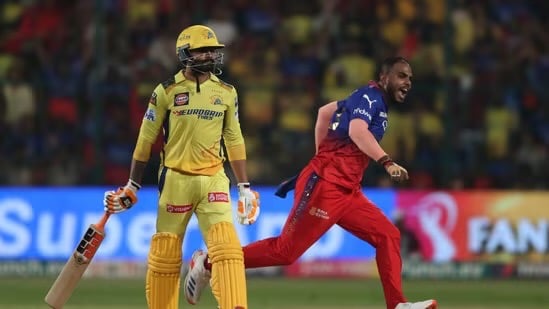
Let’s go back to May 18, 2024, at the M. Chinnaswamy Stadium.
Royal Challengers Bengaluru and Chennai Super Kings met with the final playoff spot hanging in the balance.
RCB walked in riding a six-game winning streak, needing not just a win, but a statement — a margin of at least 18 runs to complete a remarkable turnaround from the bottom of the table midway through the season. What followed was exactly that. A collective batting effort set the platform, before Yash Dayal held his nerve in a dramatic final over to seal a 27-run victory — enough to send RCB through.
But the result was only part of the story.
That night spilled over into raw, unfiltered emotion. Celebrations poured out — relief, belief, and years of frustration finding release. Rival fans were quick to mock it, saying RCB celebrated “like they had won the IPL” — a title that had eluded them for 17 years at that point, and would continue to do so as their journey ended in the playoffs that season.
And yet, with the benefit of time, that night feels like something more.
Nearly two years on, it’s hard not to look back and see it as a potential shift — not just in momentum, but in identity.
Because the Indian Premier League operates in cycles. Every three years, the Mega Auction offers franchises a chance to reset, reshaping squads while retaining only a core group. It’s a moment where philosophies are revealed as much as players are picked.
And in the auction that followed, these two teams didn’t just make different choices —
they seemed to swap roles entirely.
Royal Challengers Bengaluru — Structured and Role-Defined
For years, Royal Challengers Bengaluru were defined by star power. In 2025, they flipped the script — and in doing so, quietly took a page out of the Chennai Super Kings playbook.
The reset was bold. RCB retained just three players — Virat Kohli, Rajat Patidar and Yash Dayal — letting go of established names who had powered their late surge. It wasn’t just a squad change; it was an identity shift.
Instead of chasing marquee signings, RCB built with intent. Roles over reputation. Fit over fame.
At the top, Kohli’s stability was complemented by Phil Salt’s explosiveness — a clear contrast of tempo. In the middle order, Patidar anchored a group of pure impact hitters like Jitesh Sharma, Tim David and Romario Shepherd — players picked not for averages, but for how quickly they could change a game.
With the ball, the shift was just as clear. Rather than splurging on a single big-name spinner, RCB opted for balance — Krunal Pandya’s control paired with Suyash Sharma’s attacking threat. It was efficient, calculated, and very CSK in its thinking.
And then came the real correction. For years, death bowling had been RCB’s undoing at the Chinnaswamy. This time, they addressed it head-on — bringing in proven operators like Josh Hazlewood and Bhuvneshwar Kumar alongside Yash Dayal to build a unit designed to absorb pressure, not crumble under it.
This wasn’t a team built on names.
It was a team built on roles — every player picked for a specific job, every piece fitting into a larger plan.
The result? A maiden IPL title in 2025.
And like Chennai Super Kings have done so often, RCB didn’t stop there.
Heading into the 2026 auction, they chose continuity over disruption. Venkatesh Iyer added flexibility, Jacob Duffy strengthened the pace reserves, and an unknown left-arm seamer in Mangesh Yadav represented a calculated bet on potential.
These weren’t headline signings — they were deliberate ones.
With players like Jacob Bethell — coming off a statement T20 World Cup — adding to the bench, RCB quietly built something they had long lacked: depth with purpose.
Not just built for one title,
but built to last — in the mould of the great CSK teams.
Chennai Super Kings — Stuck in between Stability and Change
Chennai Super Kings have long been built on the cornerstones of stability and method. And true to that identity, they stayed the course heading into the 2024 mega auction.
They retained their core — Ruturaj Gaikwad, Ravindra Jadeja, Shivam Dube, Matheesha Pathirana, with MS Dhoni fitting in as an uncapped retention — doubling down on continuity. The auction that followed reflected the same philosophy. Proven, experienced names like Rahul Tripathi, Deepak Hooda, Ravichandran Ashwin, Vijay Shankar, Devon Conway and Rachin Ravindra were brought in — players familiar with the IPL ecosystem, trusted to deliver within a system.
It was consistent. It was predictable.
And for the first time in a long time, it felt outdated.
Because while CSK stayed the same, the game around them had moved on.
The T20 landscape had shifted beyond the safety of 160–170 totals and the art of strangulation with the ball — a formula CSK had perfected over the years. Even conditions, once their greatest ally, began to change. The Chepauk surface no longer offered the same assistance to spin, turning into a far more batter-friendly venue.
The result was inevitable. A difficult 2025 season that saw CSK finish at the bottom.
To their credit, the response was immediate. Mid-season, they pivoted — bringing in Ayush Mhatre and Dewald Brevis as injury replacements, players better aligned with the demands of the modern T20 game. It was a small but telling shift in approach.
By 2026, that shift had turned into a rethink.
CSK recognised the need not just to tweak, but to reset both personnel and template. Ravindra Jadeja and Sam Curran were traded to Rajasthan Royals in exchange for Sanju Samson — a move that signalled succession planning, with Samson expected to take over from Dhoni, whose career appears to be nearing its end.
The changes didn’t stop there. Ashwin moved on, Pathirana was released, and CSK entered the auction with a war chest of over ₹40 crore.
And then came the most un-CSK move of all.
Over ₹28 crore was spent on two uncapped youngsters — Kartik Sharma and Prashant Veer — handing them their first IPL contracts. It was a bold, high-variance gamble.
The kind of move you would once have associated with Royal Challengers Bengaluru of the past.
Since that night in May 2024, Royal Challengers Bengaluru have ticked off milestones that once felt out of reach — breaking the Chepauk jinx for the first time since 2008, winning another high-scoring thriller at the Chinnaswamy, and finally securing their elusive IPL title in 2025.
The head-to-head record still heavily favours Chennai Super Kings.
But for the first time in this rivalry, it feels like the equation has shifted.
Because now, it is CSK who arrive with something to prove —
and RCB who hold the momentum
And maybe that’s what makes it special.
Not just the history. Not just the stakes.
But the fact that, for the fans, this still means more than anything else