
🏈 The Super Bowl: Where American Football Becomes a Global Spectacle
Every February, the Super Bowl turns American Football into a global event. This piece explores how the National Football League (NFL) built the richest league in world sport, why the Super Bowl dominates viewership, the legends who defined it, and how this season's unpredictability has set up a fascinating finale.
2/8/20265 min read
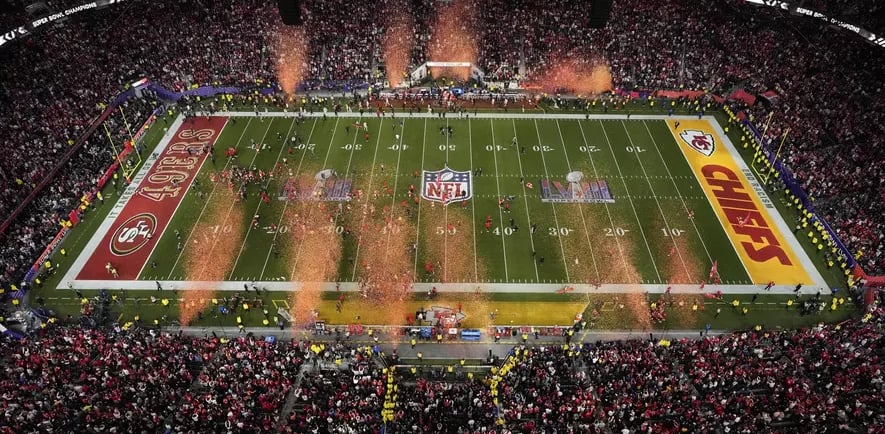
Every year, one sporting event rises above all others in American sport. The Super Bowl isn’t just the NFL’s championship game — it’s a cultural institution, a business phenomenon, and the defining moment of an entire season. For the National Football League, this is the crown jewel: the night when sport, entertainment, and commerce converge on a scale unmatched anywhere else.
What makes the Super Bowl unique is not just the quality of competition but its ability to transcend the sport itself. It attracts die-hard fans, casual viewers, celebrities, advertisers, and first-time watchers all at once. For many, it’s the only NFL game they’ll watch all year — yet it consistently delivers drama, spectacle, and conversation long after the final whistle.
At its core, though, the Super Bowl represents the pinnacle of a league that has quietly built the most powerful sports ecosystem in the world.
💰 The NFL: The Richest League in World Sport
From a business perspective, the NFL operates in a league of its own. Despite American football being largely concentrated within the United States, the NFL consistently outperforms globally popular sports leagues in revenue generation and franchise valuation.
As of the latest estimates, the average NFL franchise is valued at over $7.6 billion, a staggering figure driven by media rights, commercial partnerships, and a highly centralized revenue-sharing model. At the top of the valuation ladder sit franchises like the Dallas Cowboys, worth over $12 billion, making them one of the most valuable sports teams on the planet — across any sport.
What’s striking is that this financial dominance exists without the global penetration enjoyed by European football (soccer), cricket, or basketball. The NFL doesn’t rely on a worldwide calendar or continental competitions. Instead, it has mastered scarcity. With only 17 regular-season games per team and a tightly controlled schedule, every game carries weight — and every broadcast commands premium value.
This model has allowed the NFL to negotiate multi-billion-dollar broadcast deals that run well into the next decade, ensuring financial stability and continued growth for all 32 franchises.
🏆 The Super Bowl Economy: One Night, Billions Generated
Nowhere is the NFL’s financial power more visible than during Super Bowl week.
The Super Bowl routinely generates over $2 billion in combined revenue, spanning ticket sales, merchandise, sponsorships, hospitality, and advertising. The host city alone sees a massive economic boost through tourism, hotel bookings, and fan experiences spread across an entire week.
📊 Key Numbers That Define the Event
Ticket sales: Super Bowl ticket revenues often exceed $50 million, with average resale prices ranging between $5,000–$6,000 per seat.
Advertising: A single 30-second Super Bowl commercial costs between $8–10 million, making it the most expensive ad slot in television.
Merchandise: Super Bowl-related merchandise sales regularly cross $600 million globally.
For brands, the Super Bowl is not just an advertising opportunity — it’s a strategic investment. Companies spend months designing ads specifically for this night, knowing that nowhere else will they find such a concentrated, engaged audience.
📺 Viewership: The Most Watched Broadcast in the United States
The Super Bowl isn’t just valuable — it’s watched at an unprecedented scale.
Recent editions of the Super Bowl have attracted over 125 million viewers in the United States alone, making it the most-watched single broadcast in U.S. television history. No other sporting event, entertainment show, or live broadcast comes close on an annual basis.
What strengthens the NFL’s position further is how it dominates regular television rankings as well. In a typical year, more than 70 of the 100 most-watched TV broadcasts in the U.S. are NFL games. This dominance explains why broadcasters are willing to commit enormous sums for long-term rights.
Globally, while the NFL may not rival football or cricket in everyday viewership, the Super Bowl punches far above its weight — airing in over 180 countries and drawing massive engagement across digital platforms and social media.
🎤 When Sport Meets Entertainment
Part of the Super Bowl’s appeal lies in how seamlessly it blends sport with entertainment. The halftime show has become a cultural event in its own right, featuring global music superstars and often generating as much conversation as the game itself.
For casual viewers — especially international audiences — the halftime show acts as an entry point into the event. Combined with cinematic commercials and celebrity appearances, the Super Bowl becomes more than a football game; it becomes a shared cultural moment. Think about Kendrick Lamar 2025.
This fusion of sport and entertainment is deliberate. It broadens the audience, increases viewing time, and enhances the overall value of the broadcast — benefiting leagues, networks, and sponsors alike.
🐐 Legends of the Game: Brady, Mahomes, and Super Bowl Legacy
While the spectacle elevates the Super Bowl, it is the players who give it meaning. Over the years, the game has served as the stage where legends are defined.
No figure looms larger than Tom Brady. Across a career spanning more than two decades, Brady appeared in 10 Super Bowls and won seven championships — a level of dominance unmatched in NFL history. His success reshaped expectations around leadership, preparation, and longevity in professional sport.
In the current era, Patrick Mahomes has emerged as the defining quarterback of his generation. With three Super Bowl titles already to his name, Mahomes represents the evolution of the position — blending athleticism, creativity, and composure under pressure. His ability to consistently perform on the biggest stage has made him the face of the modern NFL and a central figure in its future narratives.
The Super Bowl has always been where careers are remembered — and for players like Brady and Mahomes, it has been the ultimate proving ground.
📘 Watching the Super Bowl for the First Time? Key Terms to Know
For new viewers, American football can feel complex. Here are a few essentials to keep in mind:
Touchdown: Worth 6 points. Scored when a player carries or catches the ball in the end zone.
First Down: Teams have four attempts (downs) to advance the ball 10 yards. Succeeding resets the count.
Field Goal: A kick worth 3 points, usually attempted when a touchdown isn’t possible.
Quarter: The game is divided into four 15-minute quarters.
Interception: When a defender catches a pass intended for an offensive player.
Vince Lombardi Trophy: Awarded to the Super Bowl champions.
Understanding these basics makes the experience far more enjoyable — especially when the stakes are at their highest.
⚖️ An Unpredictable Season Sets the Stage
What makes this Super Bowl particularly compelling is the path that led here. Unlike seasons dominated by one or two clear favourites, this year has seen several traditional powerhouses eliminated earlier than expected.
The National Football League (NFL) is divided into two conferences, the American Football Conference (AFC) and the National Football Conference (NFC), and the split of the teams into this conference dates back to the 1970 merger between the two rival leagues NFC and AFC, and not a traditional East and West like the NBA. Each conference runs its own playoff bracket, meaning the Super Bowl is the matchup between the best team of the season from the AFC and the NFC.
Upsets, injuries, and tactical mismatches reshaped the playoff picture, leaving behind a final matchup defined by balance rather than dominance. This unpredictability is a feature — not a flaw — of the NFL’s structure. Salary caps, drafts, and revenue sharing are designed to promote parity, ensuring that no team can stay on top forever.
The result is a Super Bowl that feels genuinely open — a contest where execution on the night will matter more than reputation.
In the end, the Super Bowl is more than a game. It is a showcase of how sport can evolve into a multi-billion-dollar entertainment ecosystem without losing its competitive edge. It’s where business strategy meets athletic excellence, where cultural moments are created, and where legends are cemented.
Even for those outside the traditional NFL fan base, the Super Bowl remains a must-watch event — a reminder of the power of sport to command attention on a global scale.
Because in the NFL, this isn’t just a final.
It’s the crown jewel.